Home · Impact-Resistant Roofing
Impact-Resistant Roofing · Ogden & Northern Utah
Northern Utah gets hail most summers. An impact-resistant (Class 4) roof is the upgrade that shrugs off the strikes that crack and bruise an ordinary roof. Here's what the rating actually proves, the honest limits, and which materials earn it.
Class 4 is the top impact rating a roof can earn under UL 2218, the industry hail test. To pass, the roofing takes a 2-inch steel ball dropped from 20 feet, twice on the same spot, without cracking or splitting. It's a rating, not a material: you can get it in a rubberized asphalt shingle, a synthetic like F-Wave REVIA, or metal, though the rating belongs to the specific product rather than the category. What changes between them is cost, how the roof looks, and how it behaves when hail does land. None of them is hail-proof, and we'll be straight with you about that below.
Three ways to get there
There isn't one "impact-resistant roof." Class 4 is a test result, and three very different materials pass it. We install all three and tell you which fits your home and your budget.
The affordable upgrade. These look like a normal shingle roof, but the asphalt is "rubberized" so it flexes under a hail strike instead of cracking. We can order the Class 4 line from any brand we carry: GAF Timberline AS II, Owens Corning Duration FLEX, CertainTeed NorthGate ClimateFlex, Atlas StormMaster, and TAMKO StormFighter FLEX.
Best for: the most protection per dollar. Typically 15% to 25% over a standard architectural shingle.
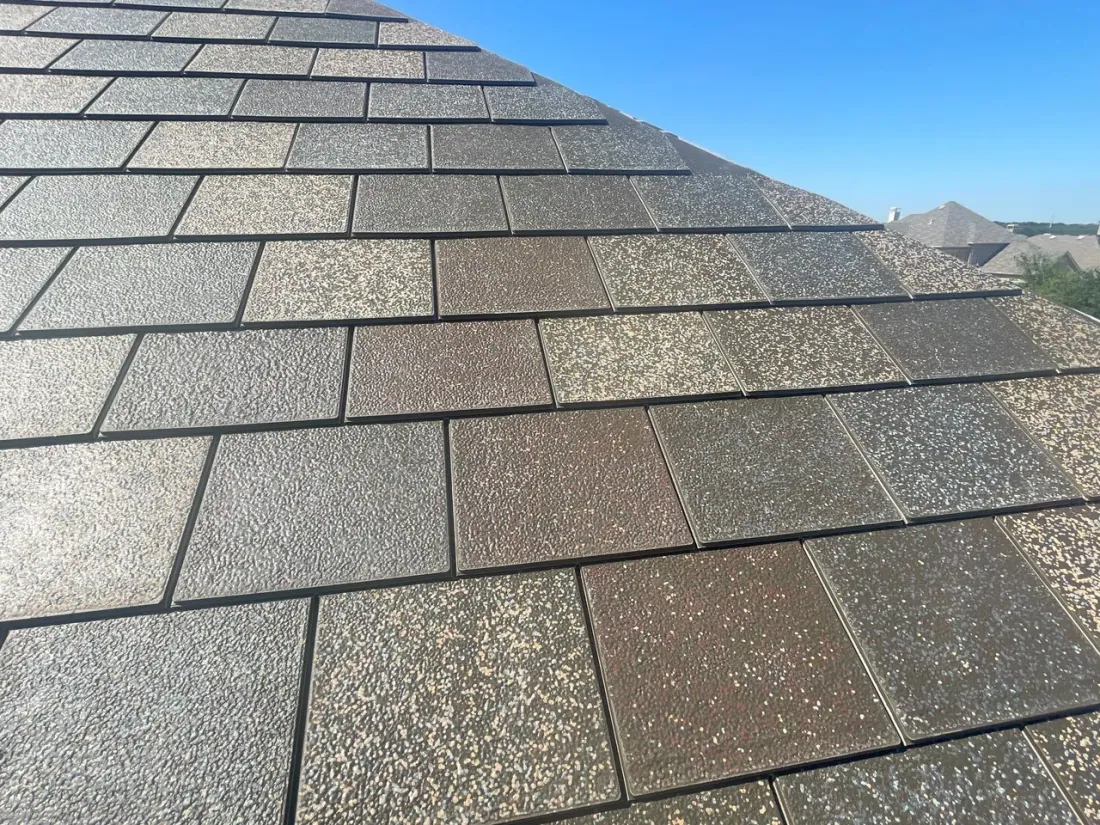
The one with a hail warranty behind it. REVIA is a solid polymer shingle, so there's no asphalt to go brittle and no granules to knock loose. It's Class 4 rated, comes in slate and shake looks, and it's lighter than asphalt.
Best for: a forever home where you want coverage, not just a rating. More below ↓
The one people forget is on this list. Standing seam, metal shingle, and stone-coated steel panels commonly carry a Class 4 rating, and metal doesn't crack or shed granules the way a shingle can. The honest tradeoff: a stone that would bruise asphalt invisibly can leave a visible dent in metal. Heavier gauge dents less, and steel dents less than aluminum, so the exact panel matters more than the word "metal."
Best for: the longest life of the three. Metal roofing →
Class 4 is earned panel by panel, not by material category, so we confirm the rating on the exact product before you buy it and give you the documentation either way.
The rating
The UL 2218 test drops a steel ball twice on the same spot. A roof passes Class 4, the highest of four levels, only if nothing cracks or ruptures through the back of the shingle. The ball sizes are matched to the energy of real hailstones, and Class 4 uses the biggest one. So a Class 4 roof is genuinely tougher, and it lowers your odds of a hail claim and a full tear-off.
We'd rather tell you this up front than sell you a roof on a promise it can't keep. F-Wave's hail warranty (below) is the exception among the roofs we install, and it puts real coverage behind the impact claim.
The premium option
REVIA is what we'd recommend when a homeowner wants a written hail warranty behind the rating, not the rating alone. It's a solid polymer shingle with the look of slate or hand-split shake, minus asphalt's weak points: no granules to shed, no asphalt to dry out and crack.

We register the F-Wave warranty for you at install, so your coverage is on file from day one. F-Wave is one of the synthetic lines we install, not the only one; if another fits your home better, we'll say so.
The money angle
Here's the part that can help pay for the upgrade: many insurers offer a premium discount for a documented Class 4 roof, because a tougher roof means fewer hail claims. Over the years, that discount can offset part of the upcharge.
Now the honest caveats, because insurance is the insurer's call, not ours:
So we never promise a discount or a claim approval. We tell you to call your insurer, ask what a Class 4 roof does to your specific policy, and factor the real answer into your decision.
If you're on a bench or open flat that catches hail, plan to stay for years, or just want fewer roof worries after a storm, the upgrade earns its keep. An insurance discount can soften the cost, and synthetic or metal makes the most sense on a forever home.
If your budget is tight or you may sell before it pays off, a standard architectural roof can be the smarter money, and we install those too. We'll run the honest math with you instead of pushing the bigger ticket.
See standard roof replacement →Impact-resistant roofing
Class 4 is the highest impact rating under UL 2218, the standard hail test. A 2-inch steel ball is dropped from 20 feet onto the same spot twice, and the roofing passes only if it doesn't crack or rupture. It's the toughest of the four classes and the one built for hail. Class 4 is a rating rather than a material, so you can get it in a rubberized asphalt shingle, a synthetic like F-Wave REVIA, or metal. The rating belongs to the specific product, not to the category, which is why we confirm it on the exact panel.
No, and any roofer who says so is overselling. Class 4 sharply lowers the odds that hail cracks your roof or forces a full replacement, but very large hail can still dent or mark any roof. The rating means the shingle resists cracking and granule loss, not that hail can't touch it. We'll always tell you what it does and doesn't do.
Many Utah insurers do offer a premium discount for a documented Class 4 roof, which can help offset the upgrade over time. But it varies by insurer and policy, some don't offer it, and some pair it with a cosmetic-damage exclusion. We give you the paperwork proving the rating; the discount and any claim are your insurer's decision, so we never promise savings. Call your insurer and ask what it does to your policy.
Class 4 asphalt is the affordable upgrade and looks like a normal shingle roof, usually about 15% to 25% over a standard architectural shingle. F-Wave REVIA synthetic costs more but has no granules to lose, comes with a 5-year hail warranty that includes labor, and looks like premium slate or shake. Metal lasts the longest of the three and won't crack or lose granules, with the tradeoff that it can dent visibly where asphalt bruises invisibly. Gauge and metal type change how much it dents. On a forever home in a hail-prone spot, synthetic or metal is often worth it. We'll help you weigh it during the free inspection.
Yes, within its terms. F-Wave backs REVIA with a 5-year hail impact warranty that includes labor, on qualifying single-family homes, covering hail up to 2 inches. Like any warranty it has conditions, including installation to F-Wave's guidelines and reporting a hail event promptly. The 5-year hail coverage sits inside F-Wave's 50-year warranty, on its own shorter clock. It's the rare case where a real warranty stands behind the impact claim, which is why we register it for you at install.
Financing available
Check real offers from more than 20 lenders through Acorn Finance in about two minutes. The initial check is a soft credit pull, so it won't touch your score. If an offer works, take it. If not, you've lost nothing but the two minutes.
Roughly $80 to $160 a month for every $10,000 financed (6.99–8.94% APR, 84–240 months). Examples, not offers.
Loans from $1,000 to $100,000 through Acorn Finance's lender network. Compass isn't a lender. Every rate, term, and approval comes from the lenders themselves, and moving forward with an offer may involve a hard credit check.
Free inspection
Tell us a little about your roof and we'll get right back to you. Prefer to talk now?
Calls returned within the hour · Mon–Sat
952 28th St, Suite D · Ogden, UT 84403
Serving Ogden & Northern Utah · Locally owned & operated
Free inspection, an honest read on your hail risk, and a written price on both the standard and the Class 4 options.