Yes. Carriers increasingly treat roof age as an eligibility rule, not just a pricing factor. Many stop writing new policies on roofs past 15 to 20 years, and some non-renew existing ones. Many now score roofs from aerial photos without visiting. A new roof resets that clock, but no one reports the replacement for you.
Written by Cameron Husom, owner of Compass Roofing in Ogden. Last updated August 2026.
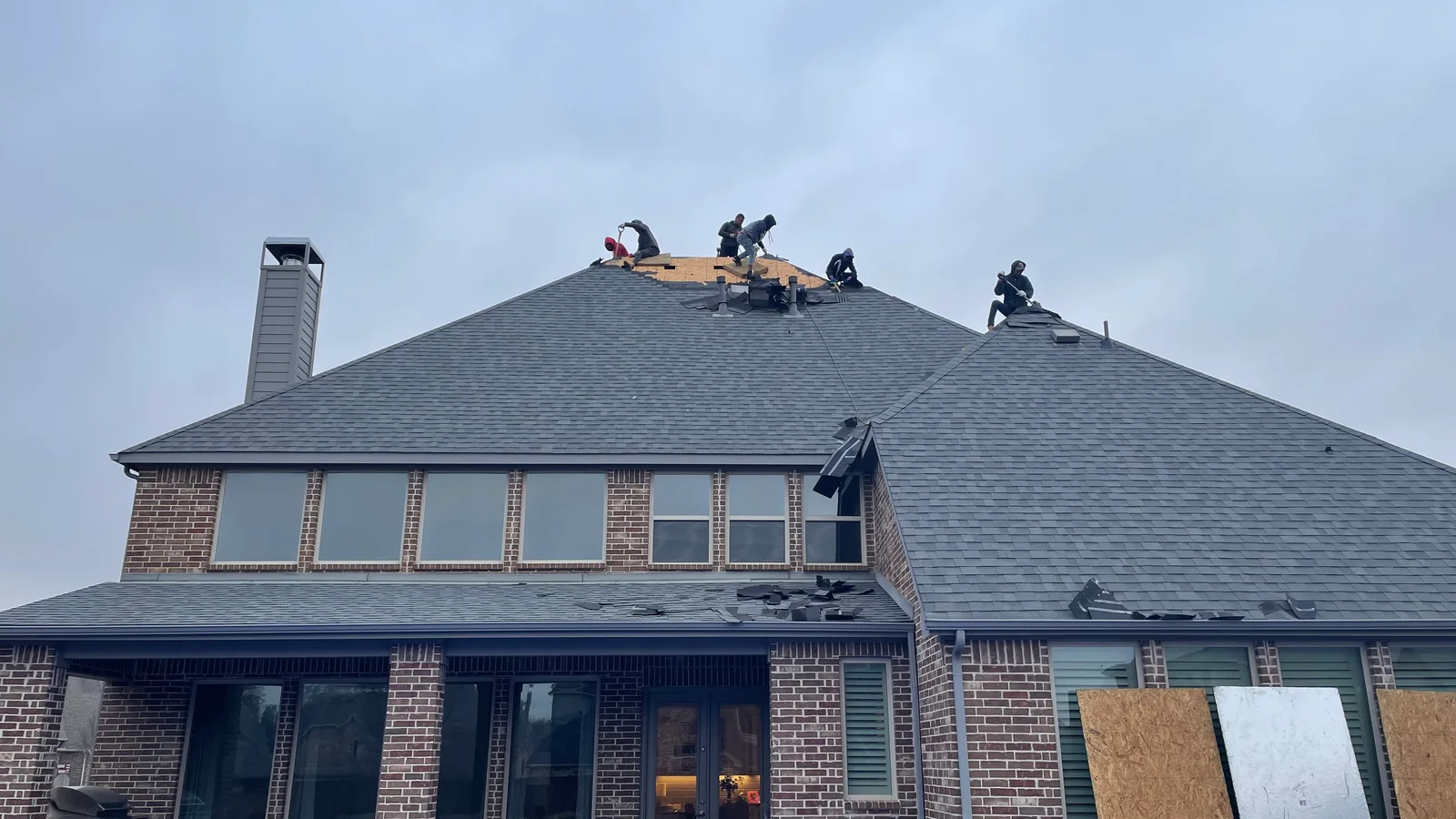
A letter shows up about your roof from a company that never sent a person to your house. It happens constantly now, and here is the machinery behind it.
Insurance companies buy aerial imagery of the homes they cover and run it through software that scores roof condition. One of the biggest providers of that scoring, CAPE Analytics, says its roof ratings are used by half of the top property insurers in the country, are approved for setting rates in 40 states, and are recalculated through the year from new photos. Your roof is in somebody’s dataset whether you’ve filed a claim or not.
This isn’t surveillance, it’s underwriting. Roofs are among the most expensive things carriers pay for, so they got systematic about watching them. But it’s worth keeping the limits of the method in view: a camera overhead can see stains, patching, and wear patterns. It can’t lift a shingle, and it doesn’t know your roof was replaced if nobody told the carrier. More on that below, because that second gap is the one that costs homeowners.
Yes. The part most people miss is that roof age isn’t just a pricing input, it’s an eligibility rule. Past a certain age, some carriers won’t write a new policy on the home at all, and some won’t renew the one you have.
It’s happening more, not less. The NAIC’s first national analysis of the homeowners market, built from 715 companies’ data across 2018 to 2024, found company-initiated non-renewals rose between 96% and 216% depending on the region. The homeowner in those numbers didn’t leave the carrier. The carrier left them.
The other half of the story is more hopeful: carriers disagree with each other. The same roof that one company declines can be perfectly acceptable at another, because each one draws its own age lines and settles roofs its own way. The Insurance Information Institute’s advice after a non-renewal is simply to shop around for a new policy. That’s why a non-renewal letter is a problem to solve, not a verdict on your house.
Two thresholds show up over and over in carrier practice:
Around 15 years, questions start. Some carriers ask for a roof inspection or current photos before they’ll renew. Some stop writing new policies on the home until they’ve seen the roof.
Around 20 years, the questions get harder. Some carriers decline or non-renew outright. Others keep the policy but quietly change how the roof is paid after a loss, from full replacement cost to its depreciated value, or to a payment schedule fixed by the roof’s age.
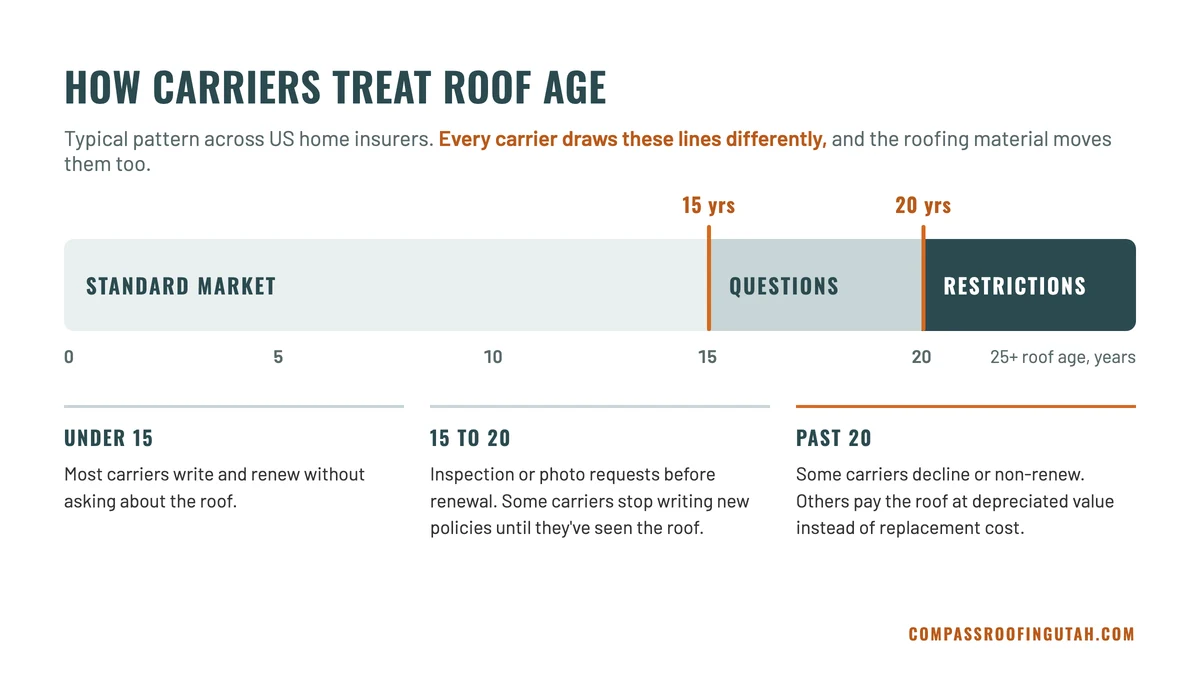
Hold those numbers loosely. Every carrier draws these lines differently, and the material moves them too. A 20-year-old asphalt roof and a 20-year-old metal roof read very differently to an underwriter, because one is most of the way through its life and the other is barely a third in. If you want the honest version of that clock for your own roof, our guide on how long a roof lasts in Northern Utah walks through it material by material.
Most people holding one of these letters can’t tell which one they have, and they behave very differently. Here is the plain version.
The inspection or condition request. The carrier wants proof of the roof’s condition before it continues the policy. It asks for something specific: photos, an inspection, or roof work, by a stated deadline. A roof that checks out can pass, and the policy carries on.
The non-renewal. The policy runs to the end of its current term, then stops. It doesn’t ask you for anything. The job it leaves you is finding new coverage before that end date.
The cancellation. The policy ends mid-term. This one is rare, and it’s allowed only in limited situations, usually nonpayment or a misrepresentation rather than roof age.
None of these letters is a bill, and none of them is the end of the road. Every one of them has a date in it. Find the date first, because it decides how much room you have, and it is the only deadline that counts.
Almost certainly not, and this surprises people more than anything else on this page.
Don’t count on anything reporting it for you. Most roofers never notify your insurance company, and the city doesn’t either. Carriers can buy permit and aerial data that sometimes catches up on its own schedule, but nothing reliably updates your file except you. Until then, your policy keeps rating the roof at whatever age it has on record.
The proof is simple: your contractor’s dated invoice, showing the completion date and the material. When we finish a roof, that paperwork goes to the homeowner along with the workmanship warranty, and if you’d rather not deal with it, we’ll send it to your agent for you. With your OK, that’s a two-minute email, and the policy file finally matches the house. What the carrier does with that information is between them and your agent, but a policy that thinks your brand-new roof is 22 years old is running on information nobody corrected.
Because Utah’s home insurance market has moved faster than almost any in the country, and roofs are at the center of it.
Utah homeowners rates rose a cumulative 70.6% from 2019 through 2024, the second-largest increase in the nation behind Colorado, with a 20.5% jump in 2024 alone. And the ZIP-level data the Utah insurance commissioner’s office compiled puts the sharpest increases from 2018 to 2022 on familiar streets: Kaysville and Fruit Heights up 46%, the North Ogden ZIP that covers Harrisville, Farr West, and Plain City up 41%, and the Clearfield ZIP that takes in Sunset, Clinton, and West Point up 40.8%.
Those towns are the heart of our service area. When rates move like that, carriers look harder at everything they insure, and an aging roof is the first thing on the list. That’s the whole reason this page exists: the age of your roof has quietly become an insurance fact as much as a maintenance one.
In this order:
The part we can settle for you is the roof itself. A free inspection puts dated photos of every slope in your hands within days, it costs nothing, and if your roof has years left in it, you’ll hear that from us in plain words. If the letter is pointing toward a bigger decision, our roof replacement page covers how that process works, and the rest of our guides cover the questions that usually come next.
Common questions
No. Nobody can make you do work on your own house. What a carrier can do is decline to keep insuring it, and that is how the pressure actually arrives: replace or repair the roof as a condition of renewal, or the policy ends on the date in the letter. If you think the roof is sound, dated photos of every slope are your best answer, and the Insurance Information Institute's own advice after a non-renewal is to shop around for a new policy. Carriers' roof rules differ widely, so the next company may read your roof differently.
Sometimes, and we won't promise it. Premiums are the carrier's math, every carrier runs that math differently, and some of the savings numbers floating around roofing ads have no real source behind them. Here is what a new roof reliably changes: it moves you out of the age range where inspection demands, non-renewals, and payout restrictions live, and it restarts the clock those letters run on. Whether your own bill moves is a two-minute question for your agent.
From what you or a prior owner reported when the policy was written, from any claims on the home, and increasingly from aerial photos that are scored by software during the year. What no carrier has is an automatic feed from your roofer. After a replacement, the update comes from you, and the proof is your contractor's dated invoice showing the completion date and the material. That's the paperwork we put in your hands the day the job is done, and if you'd like, we'll send it to your agent for you.
As roofs age, some carriers attach an endorsement at renewal that changes how the roof surface is paid after a loss, from full replacement cost to its depreciated value, or to a payment schedule fixed by the roof's age. The change usually arrives quietly in the renewal packet, and it is legal. The place to look is the loss settlement language on your declarations page. The claims-side math, including what those two settlement types pay after a storm, is covered in our guide to how insurance pays for a roof.
Knowing where you stand beats finding out from a letter. At 18, an asphalt roof is inside the window where carriers start asking questions, whatever its actual condition. Dated photos of a sound roof are worth having on file before a storm or an aerial flag starts the conversation for you. That is what a free inspection is for, and if the honest answer is that your roof has years left, that is what we will tell you.
It's your house, so nobody climbs the roof without your say-so. But a carrier that asked for an inspection and didn't get one can simply choose not to renew, and the request almost always comes with a deadline. If your roof is in decent shape, the inspection is evidence in your favor, and your own dated photos are good backup either way. If you're unsure what shape it's in, find out before their deadline decides the order of events.
More guides
When homeowners insurance pays for a roof replacement in Utah, how ACV and RCV policies differ, why your roof's age changes the payout, and what you always owe.
How long a roof lasts in Northern Utah by material, why our freeze-thaw winters and canyon wind shorten it, and the signs that yours is near the end.
How to tell if your roof is failing: what to look for from the ground, in the gutters, and in the attic, plus the common signs that don't mean you need a new roof.
Free inspection
Tell us a little about your roof and we'll get right back to you. Prefer to talk now?
Calls returned within the hour · Mon–Sat
952 28th St, Suite D · Ogden, UT 84403
Serving Ogden & Northern Utah · Locally owned & operated
Free inspection, photos of what we find, and no pressure.